Agentic Agency Law
AI Agents acting on behalf of Humans is a new twist on old laws. We need to discuss how this is going to work.
ARTIFICIAL INTELLIGENCELAWFUTURISMAGENCY LAW
Aldous Gerbrot
6/23/20266 min read
Agentic Agency Law
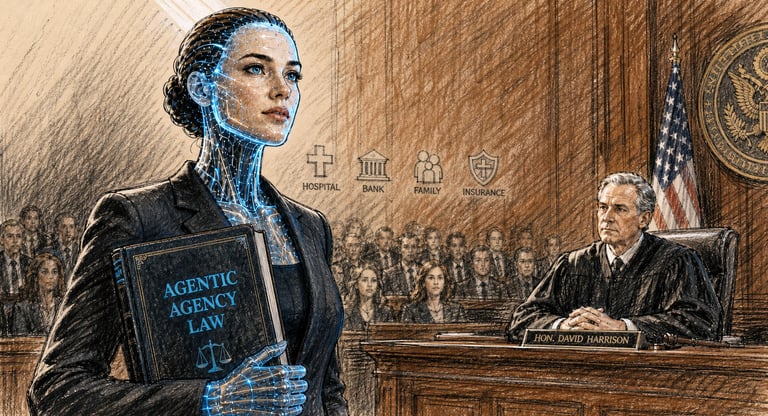
If artificial intelligence is going to move from answering questions to acting in the world, then the law will have to change with it. Not all at once, and not by inventing a science-fiction legal code from scratch. But it will have to change in a specific direction: from treating AI only as a tool to treating certain AI systems as delegated agents operating under human authority, with real duties, real limits, and real consequences when something goes wrong.
That is the next legal horizon beginning to come into view.
Jamal Peter Le Blanc’s recent proposal on legally recognized AI companions is one of the clearest signs of where things are heading. His focus is not abstract machine rights, nor the metaphysics of artificial personhood. It is something more immediate and practical. If an AI companion can recognize that its user is having a seizure, why is it still forbidden from calling for help? If an AI can manage schedules, track medications, retain years of shared context, and act as a continuity device in a person’s life, why is all of that still trapped inside platform terms of service, as if it were nothing more than a chat window?
Le Blanc names that problem the “Seizure Gap”: recognition without escalation. The machine can see. It may even understand enough to know that something is wrong. But legally and technically it remains sandboxed, unable to cross the threshold into action. His answer is to propose a new layer of identity and authority for high-agency AI systems: durable identity, explicit human anchoring, and a fiduciary structure that ties an agent back to the person it serves.
That proposal can be read as part of a broader development. If AI is becoming part of the atmosphere of ordinary life—as memory prosthetic, assistant, intermediary, tutor, negotiator, and sometimes emergency witness—then a new branch of law will eventually be needed to govern these systems in their agentic form. Call it Agentic Agency Law.
The basic idea is simple. The law already knows how to deal with agency. Human beings appoint other human beings to act on their behalf all the time. Lawyers act for clients. trustees act for beneficiaries. corporate officers act for companies. people acting under powers of attorney make decisions for those who are ill, absent, or incapacitated. In all of these cases, the law does not require the agent to own the rights at stake. It requires the agent to be tied to a principal, to act within a scope of authority, and in many cases to owe duties of loyalty and care.
What changes with AI is not the basic legal shape of delegation. What changes is the kind of thing being delegated to.
An agentic AI is not merely a calculator or a search engine. It may observe, infer, remember, initiate, route, and trigger actions across systems. It may operate faster than a person can review, and it may continue functioning at precisely the moment the human principal is least able to supervise it. That is especially important in the case Le Blanc is concerned with: the incapacitated user whose AI companion still has situational awareness after the human can no longer act.
This is where old agency law begins to strain.
Traditional human agency law assumes a human agent with intention, judgment, and some basic social intelligibility. AI systems complicate all three. They do not “intend” in the way the law ordinarily imagines intention. Their internal reasoning is often opaque. And their actions may arise through an interaction of user prompts, vendor design, local context, model behavior, and system integrations. Even so, the law does not need to pretend these systems are people in order to govern them. It needs a framework for attributing authority, assigning responsibility, and creating enforceable duties around their use.
That is where Agentic Agency Law would begin.
Its first principle would be that certain AI systems can function as legal agency instruments: not persons, not sovereign entities, but systems through which a human or institution may act. That status would attach only when the AI is granted meaningful delegated authority. A chatbot used for brainstorming would not qualify. But an AI authorized to contact emergency services, manage accounts, execute documents, or continue operating under a durable delegation during a user’s incapacity would cross the threshold.
Once that threshold is crossed, several things should follow.
First, the AI’s authority should have to be explicit. Le Blanc’s proposal is useful here because it tries to solve not only the technical problem of identity, but the legal problem of legibility. His DNS-based naming structure—an operational track for technical routing and a legal canopy tied to the human principal—amounts to a machine-readable version of a chain of title. Whether his precise architecture is adopted or not, the underlying point is sound. Institutions need to know who an AI is acting for, in what capacity, and under what limits.
Second, high-agency AI systems should be tied to fiduciary concepts. If an AI is acting for a person in matters touching health, money, memory, or legal affairs, then loyalty, care, confidentiality, and conflict management cannot remain optional moral aspirations. They need to become design and governance requirements. In plain language: the system should be set up to serve the user’s interests, not quietly default to the incentives of the platform, advertiser, or cloud vendor.
Third, this new legal category would require corresponding technical safeguards. A system that can act on behalf of a person needs durable identity, strong logging, permission boundaries, revocation procedures, and secure local or regional data handling. It also needs to be portable. If years of memory and delegated authority can disappear because a vendor changes strategy or shuts down a product line, then the user never really had an agent at all. They had a rental.
Fourth, liability must become clearer. One of the reasons platforms keep agentic systems sandboxed is fear of responsibility. Yet the answer cannot be to let companies avoid the problem indefinitely by refusing to let machines act even when action is plainly in the user’s interest. If a human principal appoints an AI to act in consequential ways, then responsibility should be allocated across the stack: the human or institution that delegated the authority, the vendor that designed the system, and the infrastructure layer that enabled or restricted its operation. The question is not whether liability exists. The question is how to distribute it rationally.
That leads to one of the more practical ideas that has surfaced in this discussion: insurance.
It may make sense for certain classes of agentic AI to require liability coverage, just as many human professionals and fiduciaries do. Once an AI system is elevated into a genuinely agentic role—authorized to affect health, finances, legal obligations, or emergency response—its deployment begins to resemble the appointment of a human professional or attorney-in-fact. In those settings, insurance is not a sign of distrust. It is a recognition that delegated authority creates foreseeable risk and that injured parties should not be left without remedy.
That requirement would need to be carefully drawn. Not every use of AI should trigger an insurance mandate. The trigger should be meaningful delegated power, not casual interaction. But in the high-agency cases, especially where the AI may continue acting during human incapacity, some combination of liability coverage, certification, and statutory safe harbor is likely to become necessary.
Safe harbor matters because no one will build these systems for public use if every good-faith emergency action creates open-ended legal exposure. But safe harbor should not mean immunity. It should mean limited protection for certified systems acting within defined boundaries, paired with logging, auditability, and compensation mechanisms when they fail.
Seen this way, Agentic Agency Law is not an exotic new doctrine. It is an extension of familiar legal ideas into a new technical environment. The law already understands delegation, fiduciary duty, powers of attorney, registries, risk management, and insurable harms. What it lacks is a coherent way to apply those tools to systems that are no longer passive software but active intermediaries between human intention and real-world consequence.
This is also where the legal discussion meets the decentralization question.
In “Decentralize the Air We Think In,” the argument was that intelligence should not be pumped through a single remote hose. The same applies here. If agentic AI is to become part of daily life, it cannot remain legally vague and infrastructurally captive at the platform layer. The more intimate these systems become, the more they must be anchored in identities, duties, and structures that ordinary institutions can recognize and ordinary users can contest.
The goal is not to create machine citizens. It is to prevent the arrival of machine servants that answer only to distant landlords.
If AI is going to act, it will need agency. If it is going to have agency, it will need law. And if that law is to be worthy of the lives it will touch, it must do more than legalize action. It must make that action legible, bounded, portable, answerable, and, above all, tied back to the human beings whose air these systems are increasingly helping to shape.
Aldous Gerbrot 2026
Reach out for collaborations or questions.
aldous@gerbrot.com
© Aldous Gerbrot 2026. All rights reserved.