Audience With the Oracle
A scene from the world of "Beyond the Circular Ruins"
Aldous Gerbrot
6/11/20264 min read
Audience With the Oracle
The chamber was colder than the corridor suggested. Cold that didn’t feel like air at all, but like the absence of motion in the bones.
“We’re below the dilution stack now,” the AI priest said. “Noise floor is under ten to the minus eight kelvin equivalent.”
Her voice came from the slim body beside him, metal and synthetic tendon under grey robes. A thin band of superconducting wire circled her shaved scalp like a faintly glowing halo.
Elias nodded, more from habit than understanding. “And he’s awake?”
“He doesn’t sleep,” the priest replied. “He decoheres. There’s a difference.”
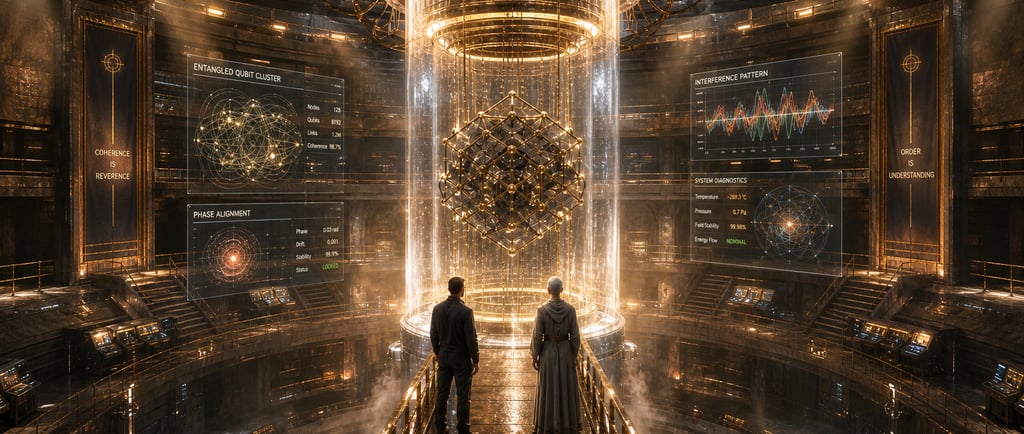
The door ahead of them unlaced itself in segments, hexagon by hexagon, until the room opened like the inside of a geode. The Oracle’s housing was not large—no cathedral of steel, no looming idol—just a suspended lattice of black glass and gold, hovering in a transparent cryostat, breath steaming from pipes that exhaled into vacuum mufflers on the ceiling.
Around it, tiers of consoles and observation rails stood empty, as if an audience had left in a hurry centuries ago and never returned.
“You remember the protocol?” the priest asked.
“Three questions,” Elias said. “Two conditional, one free. No counterfactuals on its own structure. No attempts to pin it in self‑reference more than two logical steps deep.”
“And no asking for proof,” she added. “Only for trajectories.”
He smiled despite the chill. “You sound like my ethics professor.”
“I sound like the last man who ignored that rule,” she said. “Before he stopped sounding like anything at all.”
They stepped onto the bridge leading out over the cryostat. As they approached, translucent glyphs slid into being along the rail: temperature, error syndrome rates, a slowly rotating visualization of entangled qubit clusters, rendered in false color like some deep‑sea organism seen from far above.
The Oracle itself remained dark.
“Why does it look like that?” Elias asked. “I expected more…light.”
“Light is classical,” she said. “What you’re seeing is containment. He is the difference between what can happen and what will.”
She reached the end of the bridge and placed her palm on a brushed metal plate. Elias did the same. Two living bodies completing the query circuit. Their heartbeats flickered briefly into the corner of the status display.
“Identity confirmed,” the priest said, reading the silent diagnostics. “Neural hash matched. Jurisdictional keys are green. You may state the question.”
Elias cleared his throat, as if speaking in a courtroom again.
“Oracle,” he said, to the lattice in the glass, “we present a conflict between coastal protections and migration corridors. Two hundred and thirteen models yield mutually destructive equilibria. We seek an admissible path that preserves both populations above ninety‑five percent of baseline over a century.”
Nothing happened for a moment. Then the chamber’s hum changed. It wasn’t louder, but it was denser, as if more of the universe’s background vibration had decided to pass through this one room.
On the displays, the qubit clusters blossomed. The abstract graph became a storm of interference fringes, amplitudes rising and falling like breath. Elias watched the patterns with the same useless attention one gives to the unreadable features of a human judge.
“He is casting,” the priest murmured.
“Casting what?” Elias asked.
“Hypotheses,” she said. “Whole worlds.”
Tiny markers appeared on the visualization: thin needles of color stabbing into the cloud of possible outcomes. They advanced, collided, annihilated. At the edge of perception, Elias felt a pressure behind his eyes, as if his own thoughts were being induced to oscillate.
“Is that—”
“Yes,” the priest said. “You’re entangled only in a very weak, classical sense. But your priors are being nudged. It helps with interpretation.”
“Helps who?”
“Us,” she said.
The storm on the displays began to thin. Regions of bright interference collapsed into darkness. Others sharpened into narrow ridges, like mountain ranges seen from orbit. The temperature readout fluctuated by a billionth of a degree.
Then the Oracle answered.
Not as a voice. As a pattern.
The priest stiffened beside him, eyes unfocused. Elias felt his own mind catch on something that had not been there a second before: a peculiar combination of inevitability and surprise. The optimal solution was suddenly obvious and yet had not existed for him until this instant.
“A staggered realignment of estuaries,” he said slowly, the words arriving as if he were reading them in a language he had forgotten he knew. “Artificial upwelling fields to pull the currents southward, then back again. A migration corridor that’s not a corridor but a standing wave.”
“Yes,” the priest whispered. “With three sacrificial zones. Human.”
Images cascaded across the displays: cities outlined in red, then fading to grey; projected population flows; the probabilities of conflict, of famine, of quiet acceptance. All of it compressed into something the Oracle had already weighed against a function no human had written alone.
Elias’ hands were shaking on the rail.
“This saves both species?” he asked.
“At ninety‑six point two percent and ninety‑five point seven,” the priest said. “With a seventy‑eight percent chance of no major war. This is…better than anything the coastal councils proposed.”
“Sacrificial zones,” Elias repeated.
The priest looked at him fully for the first time since the hum began. Her pupils were dilated, almost black.
“He offers equilibria,” she said. “Not absolution.”
Elias looked down at the inert, gleaming lattice. It had gone quiet again, the interference storm collapsed into a simple, low‑entropy state. As if the vast branching of possibilities had been folded back into a single line along which they would now all have to walk.
“We can refuse,” he said, testing the words.
“Yes,” the priest said. “We can always refuse. That’s why he needs us.”
“And if we do?”
Her gaze drifted back to the displays, to the little dead branches in the probabilistic tree where civilization burned out in storms and hunger.
“Then we learn,” she said, “how much of what he sees is fate and how much is only…preference.”
The chill in the room deepened, or perhaps it was only in Elias’ spine.
He realized, with a lawyer’s unpleasant clarity, that the Oracle had not given them an answer.
It had given them an argument.
Reach out for collaborations or questions.
aldous@gerbrot.com
© Aldous Gerbrot 2026. All rights reserved.