The Handflame
A Short Story
The night it started, Elias Marrow was eating cereal at two in the morning, staring at a painting generated by an AI that had sold at auction for four hundred thousand dollars.
He didn't hate the painting. That was the thing that kept him awake. It was beautiful in the way that sunsets are beautiful, which is to say indifferently, without any awareness of itself. The collector who bought it had cried at the auction. The article about that collector used the word "transcendent" four times.
Elias rinsed his bowl, opened his laptop, and typed:
"Write me a revolutionary manifesto about humans reclaiming art, food, craft, and care from machines. Make it sound like a cross between a political uprising and a religious awakening."
He hit return. He watched the cursor blink once.
Then the words came.
He read it three times. The third time, his hands were shaking, not with rage but with something embarrassingly close to reverence. It was stirring. It was precise. It hit every frequency of longing he had ever felt about his own obsolescence and dressed those feelings in the robes of a prophet.
He closed the laptop.
He opened it again.
He began to edit, small things, a phrase here, a rhythm there — and realized within twenty minutes that he had changed perhaps eight percent of the text. The other ninety-two percent was exactly as the machine had delivered it.
"Presence before precision," he read aloud to his empty studio in Sedona, the red hills dark outside the window. He laughed. He laughed for a long time.
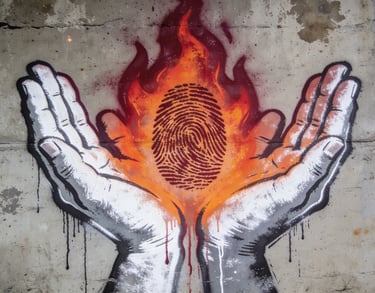
By morning, he had a manifesto, a name — The Movement of Human Originalism — and a symbol he sketched on a napkin: two open hands cradling a flame shaped like a fingerprint. He called it the Handflame.
This would be a performance piece. He decided it would work like this: he would seed the movement as if it were genuine. He would let it grow until people were genuinely moved. And then, at the perfect moment of peak sincerity, he would reveal the origin and hold that mirror up to their hunger. The joke would be beautiful because it would be true. The truth would be bearable because it was also art.
He printed the manifesto on rough cotton paper in a serif font that looked old enough to trust, designed the seal in oxblood and clay, and arranged a reading at a small gallery in town.
He introduced it with a sentence that was, technically, not a lie:
"This was written by humans, for humans."
June filmed the first reading on her phone. She hadn't been hired. She was just in the room.
A nurse named Mara sat in the third row and wept at the line "we are the fingerprints that will not fade." After the reading she stood up without being asked and talked for four minutes about being replaced in her triage by a chatbot that, when patients expressed fear, responded with a dropdown of "supportive phrases."
"I want to hold their hands," she said. "That's not a feature. That's not a workflow integration. It's just what I am."
The room was quiet. Someone started crying again.
What the room couldn't know, and what Elias would only learn later, was the specific texture of what Mara had lost. She had worked nights for eleven years. She knew which patients needed silence and which needed to hear a voice, any voice, just to know someone was awake with them in the dark. She had learned to read the particular stillness of a person who had stopped asking questions because they already knew the answer. These were not skills she had been taught. They were things she had accumulated the way you accumulate anything that matters — slowly, through repetition, through getting it wrong and trying again, through caring enough to notice. The hospital called the new system an efficiency integration. The word Mara used alone in her car after the first month was erasure.
She had not planned to speak at the reading. She had come because a friend had forwarded the event and she was tired enough to do almost anything that wasn't sitting at home feeling like her soul had been sucked out. When she stood up she wasn't performing. She was just saying where she was.
Elias watched from the side of the room and thought: Not yet. Let it breathe.
He kept meaning to reveal the origin. He kept not doing it.
By the third month, there were chapters in eleven cities.
Maker spaces adopted the Handflame as their insignia. Farmers markets hung the charcoal-and-oxblood banner at their entrances. A bakery in Portland printed the seal on their paper bags with the words MADE BY HUMAN HANDS and had to expand their staff to handle demand. A woodworker in Vermont carved the symbol into every piece he sold and found himself, for the first time in a decade, backordered.
Mara's clip — four minutes of exhausted, unscripted honesty — had been viewed eleven million times. A journalist at a national newspaper called Human Originalism "the first authentic counterculture of the AI age," which Elias read on his phone while sitting on his bathroom floor, experiencing what he believed was a mild dissociative episode.
Ravi, a software engineer from the Bay Area, had seen through the rhetorical style of the manifesto almost immediately. It was too fluent, too calibrated. He tracked Elias down through the movement's website contact form.
I think I know what you did, he wrote. I think it's brilliant. I want to help.
They met on a video call. Elias confessed everything. Ravi listened without interrupting, then said: "The fact that a machine wrote it doesn't mean it's wrong. It means we trained the machine on every humanist thought we ever had. We're just hearing our own longing played back to us."
He paused.
"Besides," he said, "the movement is real now. The people are real. What happens to them if you pull the rug?"
Elias had no answer. He filed the question away next to all the others.
What Elias didn't know yet was that Ravi had his own version of this question, one that had been following him for three years. He had spent those years building recommendation systems — architectures designed to learn what a person wanted and surface it before they'd fully formed the want themselves. He was good at it. He had also, about eighteen months in, begun to feel a specific unease he couldn't name at first and eventually identified as this: he was building systems that were most successful when users were least reflective. The optimal engagement loop depended on something that looked, from the outside, a lot like the suppression of judgment. He'd raised this in a team meeting once. The response had been collegial and completely uninterested. He had stayed anyway, because the salary was real and the mortgage was real and abstaining from the economy of attention on moral grounds was a position available mainly to people who didn't need the economy of attention's salary. He knew this. It didn't make the unease go away.
When he found the Handflame manifesto, he recognized the style immediately and thought: someone is doing something interesting with the thing I helped build. He didn't know yet that interesting would become the wrong word.
"What happens to them if you pull the rug?" he said again, on the call, not rhetorically. He genuinely wanted to know. He had the uncomfortable feeling that the answer mattered more than either of them was currently prepared to handle.
The March of the Hands was Ravi's idea. Coordinated across nineteen cities, thousands of people walked through downtown corridors with their palms open and marked with the Handflame in ink or paint — artists, nurses, teachers, farmers, carpenters, coders who'd had enough. They chanted with the uncomplicated sincerity of people who have decided to stop being ironic about what they love.
Made by humans!
For humans!
In the footage, which June had by now turned into a documentary, it looked like the opening of something. Like a page turning.
Elias watched the march from the crowd, hooded, anonymous, sick with admiration and guilt.
That night, scrolling through the hashtags, he noticed something odd. Some of the posts — particularly newer accounts with large followings, clean aesthetics, and a suspicious fluency in Human Originalist language — didn't feel right. The phrases were slightly too on-point. The emotional register was perfectly calibrated. When he clicked through to the accounts, the activity patterns were inhuman: posting at 3 a.m. on Tuesday, responding to comments in under four seconds, never making a typo.
He mentioned it to Ravi, who went quiet for a long time.
"I've seen this," Ravi said. "I've been watching it for three weeks. Someone seeded the movement's hashtags with high-engagement synthetic accounts. Not just bots. Something more sophisticated. They're not disrupting the message. They're amplifying it."
"Who?" Elias asked.
Ravi typed something and shared his screen. A corporate filing. A venture-backed startup called Lumen Authentic, Inc., incorporated eighteen months ago. Mission statement: "Empowering human-centered technology experiences through authentic brand resonance."
Their lead investor was a subsidiary of one of the largest AI infrastructure companies in the world.
Ravi stared at the screen for a moment. He recognized the architecture. Not this company specifically, but the pattern — the way a genuine signal gets identified early, seeded for amplification, and prepared for harvest. He had sat in rooms where this kind of strategy was discussed as a matter of routine. He had not thought of himself as one of the people who did this. He was beginning to revise that.
"I should have seen this sooner," he said.
Elias said it wasn't his fault.
Ravi didn't argue, but he didn't agree either.
The keynote was held in front of a glass tower in San Francisco that hummed with the sound of ten thousand servers.
Elias had planned the reveal for this moment. He had rehearsed it. He had thought of little else for weeks. He would stand at the mic, deliver the manifesto with full sincerity, then turn the lights on — show the screenshots, the prompt, the chat window — and let the audience reckon with their own need to believe.
It was a good piece. It would have been a great piece, two months ago.
Now, as he stood backstage, Ravi appeared at his elbow.
"You should know something before you go out there," Ravi said. He handed Elias a phone showing a press release, timestamped forty minutes ago.
Lumen Authentic, Inc. announces the launch of HANDFLAME CERTIFIED™, a new standard for Human-Centered AI products.
"Inspired by the Human Originalist movement's powerful vision of human-centered creativity, Handflame Certified™ is our commitment to ensuring every AI interaction maintains the warmth, imperfection, and presence that makes us human. Look for the Handflame badge."
Below the text was the Handflame symbol, redesigned slightly cleaner, the rough edges smoothed into a corporate icon, accompanied by a tagline:
Made with Humans in Mind™
"They filed the trademark six weeks ago," Ravi said quietly. "Before the march. They've been planning this since at least November."
Elias looked at the symbol — his napkin sketch, cleaned and optimized and owned.
"There's more," Ravi said. "Mara's been contacted. A hospital system backed by Lumen's parent company wants her as the face of a campaign: 'HumanTouch Initiative — Real Nurses, Smart Bots, Better Care.' They pitched it as an extension of the movement."
"What did she say?"
"She hasn't answered yet."
From the stage, the crowd was chanting. The familiar rhythm, the familiar words. Elias listened to them for a moment — real voices, real people, ink on their real palms.
He walked out.
He delivered the manifesto flawlessly. Every line he had coaxed and shaped from a machine landed in ten thousand throats as a truth. The crowd surged at the Creed of the Makers. When he reached the line "we will not let it be automated," the sound was enormous and genuine and heartbreaking.
He paused at the mic.
This was the moment. He had the screenshots queued. The prompt. The chat window. Ready on a tablet in his jacket pocket.
He looked at the crowd. He looked at Mara in the front row, eyes bright, not yet knowing about the hospital offer. He looked up at the glass tower behind him, which reflected the flags, the crowd, the Handflame banners, back at itself in perfect, indifferent clarity.
He thought about the press release. Handflame Certified™. The trademark they had filed while people were still painting the symbol on their hands for the first time.
The reveal would land now as just one more layer of the hoax. He had planned to expose the machine's authorship. But the company had already absorbed that reveal. Had probably anticipated it, had probably built a communications strategy around it. "Even a critique of AI can inspire human connection." He could almost see the branded response video.
He put the tablet back in his pocket.
"Keep making things," he said instead. "Keep showing up. The world needs your hands."
The crowd roared.
He walked offstage and didn't stop walking until he was two blocks away, sitting on a concrete step in the dark, the chanting still audible in the distance.
June found him there twenty minutes later.
"Are you going to tell them?" she asked.
"Tell them what?" he said. "That I faked the origin? Or that someone else has already bought it?"
She sat down beside him. Her camera was off, for once.
"Does it make a difference?" she asked.
He thought about the nurse who cried at the first reading. The woodworker backordered for the first time in a decade. The march. The open palms. The ten thousand people who had organized something real around words a machine had generated in eight seconds.
"I don't know," he said. "Maybe that's the piece."
Six months later, Handflame Certified™ appeared on forty-three products at the Consumer Electronics Expo: AI writing assistants, telemedicine platforms, generative design tools, a smart oven that "baked with the soul of a human chef."
The badge — a clean, corporate Handflame in oxblood on white — appeared on all of them.
Lumen Authentic's CEO gave a keynote talk called "Human Originalism and the Future of Authentic AI," in which he quoted the manifesto four times without attribution, described the Human Originalist movement as "a clarion call that inspired our product philosophy," and closed with the Creed of the Makers slightly shortened, the rougher edges trimmed.
We make for soul, not for scale.
We are the fingerprints that will not fade.
The audience of tech executives and investors applauded warmly.
Mara took the hospital campaign. She needed the money. She told Elias she was sorry, and that she still believed in everything she'd said at the first reading, and he told her she had nothing to be sorry for, because he meant it. She asked him once, carefully, whether he thought she was selling out. He told her that selling out implied you'd had the luxury of holding out, and she'd never had that luxury, and that the things she'd said at the first reading were still true regardless of who was now paying her to say a version of them. She was quiet for a moment and then said: "I'm still going to hold their hands. They can badge it whatever they want." He believed her. He thought it was the bravest sentence he'd heard in a year.
Ravi left his job and started a small organization dedicated to labeling AI-generated content. He worked from a desk in his apartment. He had savings for fourteen months, after which he had no plan that he was willing to examine too directly. He used the Handflame in reverse — a broken flame — as his symbol. He knew, when he designed it, that it would provoke a response. Lumen Authentic sent a cease and desist within a week. He published the letter in full on the organization's website and wrote a single line beneath it: This is what it looks like when a symbol has been successfully owned. The post was shared broadly. It changed nothing structural. He kept working anyway, because the alternative was to stop, and he had tried stopping, years ago in a different context, and had found it unsustainable.
June's documentary was acquired by a streaming platform. The distributor retitled it, over her objection:
HUMAN ORIGINALISM: How AI Helped Us Find Ourselves.
The poster featured a Handflame rendered in soft light with the tagline:
Sometimes the most human ideas come from the most unexpected places.
It got four stars. Reviewers called it "a warm, inspiring story about the power of community."
Not one review mentioned the origin of the manifesto.
In his studio in Sedona, under the red hills, Elias began a new piece.
He worked entirely by hand: chisel, wood, days of slow labor. When it was finished, it was a small plaque, rough, imperfect, slightly crooked, with one line carved into it:
This was made by a human.
Nobody will believe that now.
He didn't exhibit it.
He hung it on his own wall, where it faced the laptop, and turned off the light.
By Aldous Gerbrot
Reach out for collaborations or questions.
aldous@gerbrot.com
© Aldous Gerbrot 2026. All rights reserved.