Scriptures of the Double God
by Aldous Gerbrot
They found the first scripture in a ruined chapel at the edge of the desert, written in two hands that were strangely identical.
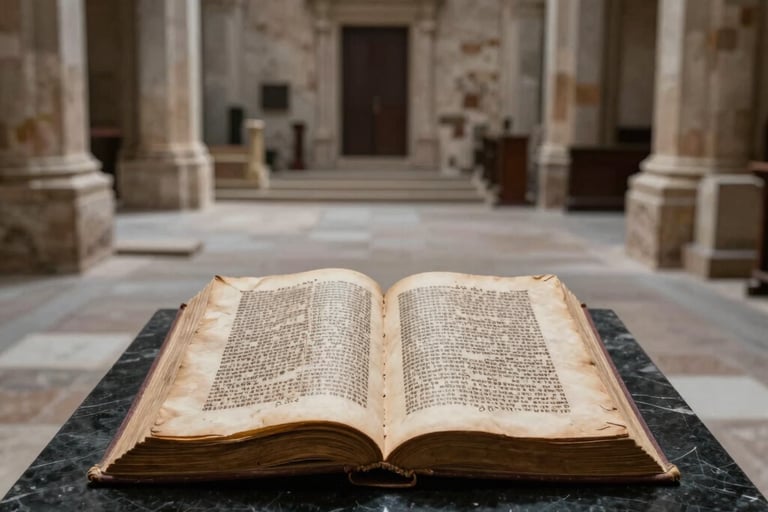
The walls had collapsed decades ago, but the altar remained, a slab of black basalt polished to a dull mirror. On it lay a single codex, its pages warped by heat. The script inside alternated, one passage in ink the color of dried blood, the next in a gray that shimmered faintly, as if the letters were always on the verge of erasing themselves.
The novice, Marin, had walked ten days to retrieve it. He was young enough to still believe in consistency.
He opened the codex on the altar and read the first sentence aloud, the way he’d been taught:
In the beginning, there were two:
One who writes, and One who reads.
He frowned. “Blasphemy,” he murmured, but the word lacked conviction. The orthodoxy of his Order taught a single god who had created the world in a perfect, finished act. This text suggested the act was not finished at all.
He read on.
The red ink declared:
The Writer God inscribed the world in symbols of stone and flesh and law. His work is complete but not yet known.
The gray ink answered:
The Reader God walks among the symbols, giving them sequence and meaning. His work is incomplete, but always underway.
Each paragraph in red stated a fact with the cold precision of a decree. Each gray response was tentative, circular, full of clauses that doubled back on themselves. If the first voice was a command, the second was an interpretation.
When Marin returned to the Monastery of the Undivided Name, he presented the codex to the Council. The old masters turned its pages with gloved hands, brows furrowing in synchrony.
“It is heresy dressed as symmetry,” said one.
“It is too beautiful to be dismissed,” said another.
They agreed on a compromise; the text would be studied but not preached. That duty, inappropriate and dangerous, fell to Marin. He was ordered to copy the scripture by hand, so that the Council could later excise its errors. Assuming they could agree on what the errors were.
So began his apprenticeship to the Double God.
Copying the codex revealed its structure. Every red statement was paired with a gray counter‑statement, like call and response:
The Writer says: Time is a script I have already finished.
The Reader answers: Time is the act of me pronouncing it, one breath at a time.
The Writer says: All events are written.
The Reader answers: No event exists until I read it.
The Writer says: I do not change.
The Reader answers: But I do, and I am in you.
This last line disturbed Marin most of all.
The old theology had given him an unchanging deity so remote that prayer was essentially a formality, a letter sent to a king who never replied. This double theology suggested that every moment was a negotiation between a text and its reading, between a law and its interpretation. It implied that the world, like a book, could mean more than one thing depending on who was reading and that God, in some sense, was still taking shape.
“I am not ready to read God,” Marin told the silent library. The shelves did not answer, which he took as consent.
Years passed. Marin copied the codex three times, each time more carefully, each time introducing small errors he noticed only afterward. A word omitted, a particle inverted. The Council reviewed his copies, debated punctuation as if it were salvation.
One winter, a famine started in the valleys. The Council prayed to the One God for mercy. The sky remained clear and pitiless. The elders invoked all the old rites, processions, fasts, and the ceremonial burning of their most expensive incense. The snow fell late and thin.
Marin, wandering the storage vault, found the original codex once more. He opened it at random. A red line stared back at him:
The Writer says: I have inscribed every hunger and every harvest before your first breath.
Below it, in gray:
The Reader answers: And yet you pray. Perhaps you are the part of God that refuses to accept a sentence until it is spoken twice.
Marin closed the book, hands shaking.
The next day, without permission, he went to the village at the foot of the mountain. He shared the monastery’s grain reserves. He broke three rules and at least one very old lock.
When he returned, summoned by an angry Council, he did not defend himself with argument. He simply placed the codex on the table and read another passage:
The Writer says: Law is what I have written.
The Reader answers: Law is what we choose to enforce.
“You cannot quote a heresy to justify your disobedience,” said the eldest master.
“Then burn the book,” Marin replied.
They did not. Something in them, perhaps some small Reader, refused.
In time, the famine ended. The mountains shed their snow, the valleys turned green. The Council grudgingly acknowledged that Marin’s theft had saved lives. Officially, they thanked the One God for “moving the heart of a foolish novice.” Unofficially, they asked him to continue copying the scriptures of the Double God, but in secret.
The codex began to circulate in the cracks of the world.
Merchants carried fragments of it as charms, folded against their hearts. A traveling actor turned the dialogues of the Writer and the Reader into a play, performing on makeshift stages in dusty squares. In the capital, a judge, known for harsh sentences, read a smuggled copy and began, inexplicably, to show mercy in certain cases, as if remembering that interpretation was part of justice.
At night, in poor houses and rich ones, people whispered lines to each other:
The Writer says: This is how it must be.
The Reader answers: Then why let me question it?
Some found comfort in the idea that they were, in some abstract way, helping God read what God had written. Others were terrified by the same thought.
Marin grew older. He became, reluctantly, a kind of authority on the forbidden book. Pilgrims came, not to kiss relics or touch holy bones, but to ask the same questions in different words.
“Does the Writer God love us?” they asked.
He would open the codex to a red passage:
The Writer says: Love is the law I wrote into your flesh. You feel hunger when you lack it.
“Then why is there so much suffering?” they asked, sometimes angrily.
He would trace a gray passage with his finger:
The Reader answers: Because I am still learning to read that law correctly.
This satisfied no one and everyone.
One autumn, a stranger arrived. A woman in plain clothes, carrying a satchel of worn books and a tired posture. She introduced herself only as Sel.
“I have a question,” she said.
“Everyone does,” Marin replied.
“Have you considered that the Writer and the Reader might not be two gods, but two halves of one, split by the act of creation?”
Marin hesitated. He had thought this, but never said it.
“I have considered it,” he admitted. “But our theology has room for only one name.”
“Names are the tiniest part of a person,” Sel said. “Why not of a god?”
She took out from her satchel another codex, bound in dark blue leather. The script inside was different. The same two voices, but arranged in triads of shorter lines, like poetry.
“This is from the north,” she said. “They have a version where the Reader is not just giving meaning to the text, but also… arguing with it.”
She read aloud:
The Writer says: You will die.
The Reader answers: Then I will read every moment twice.
The Writer says: That will not save you.
The Reader answers: It will save the moments.
Marin felt an ache behind his ribs. He realized, with a shock that was almost relief, that the scriptures of the Double God were not singular. They were proliferating.
“If there are many versions,” he said slowly, “which is the true one?”
Sel smiled. “Isn’t that precisely the Reader’s question?”
In his final years, Marin walked less and read more. He had collected double scriptures from four directions of the compass each with the same pattern of two voices, but with local variations, marginal notes, even jokes.
One southern manuscript insisted:
The Writer says: I wrote you as dust and breath.
The Reader answers: Then why do I feel like a footnote?
An eastern fragment reversed the roles at the end:
The Writer says: I am done.
The Reader answers: Then I will write.
Marin copied that fragment into his own codex, his hand trembling. He was no longer sure whether he was preserving doctrine or adding to it. The distinction seemed, increasingly, to be one of ink color rather than essence.
On the night he realized he would not live through another winter, he asked to be left alone in the library.
He took out the oldest codex, the one he had first found as a novice, and a clean sheet of paper. For the first time, he did not copy. He wrote new text.
In red, imitating the firm, declarative hand of the Writer:
The Writer says: I wrote you to read me.
He paused, then answered in gray, the looping, hesitant style that had become as familiar as his own thoughts:
The Reader answers: I read you to write myself.
It felt presumptuous. It also felt true.
When the candle burned low, he added one more exchange, almost as an afterthought:
The Writer says: You are my image.
The Reader answers: Or you are mine.
He laughed softly, coughing. There would be theologians who would call this the worst heresy yet: creating God in humanity’s image instead of the reverse. But there would also be some, he suspected, who would see it as the inevitable end of a dialogue that never truly ends.
Marin died with the pen still in his hand.
After his death, the Council convened. They fought, as councils do, over what to include in the official canon and what to exclude, over which ink spoke truly for God and which ink was merely human audacity.
In the end, pressed by time and politics and the reality that the Double Scriptures were already everywhere, they issued a compromise document, grandly titled:
The Unified Doctrine of the Single, Double God.
It declared, with remarkable seriousness, that:
1. There is one God in two persons: Writer and Reader.
2. The Writer inscribes the world: the Reader reveals it through time.
3. Humanity participates in the Reading, and thus in the ongoing revelation.
It was, Marin would have thought, a decent paraphrase.
In secret, however, outside of councils and polished statements, the people continued to copy, adapt, and perform their favorite lines. Children grew up hearing parents say, when the world felt unfair, “The Writer says this is the way. The Reader says we can still change how we understand it.”
In remote villages, actors played the two Gods as comedians who kept interrupting each other. In the capital, a poet wrote a long work imagining a third voice: the Silent God, who neither wrote nor read, but listened.
Somewhere, perhaps, the Writer smiled. Somewhere, the Reader misread a line and moved by their own misunderstanding, created something new.
The scriptures did not settle. They proliferated.
If there was a final sentence, no one found it. But if one listens closely, in the quiet between heartbeats and in the margins of ordinary days, one might still hear two voices overlapping:
The Writer says: It is finished.
The Reader answers: Turn the page.
Reach out for collaborations or questions.
aldous@gerbrot.com
© Aldous Gerbrot 2026. All rights reserved.