Who Owns the Air We Think In?
AI is quietly becoming infrastructure like electricity and water. Here’s why that changes everything about how we should govern it.
Aldous Gerbrot
6/6/20267 min read
Who Owns the Air We Think In?
There’s a moment in the life of every transformative technology when it stops being a product and starts being the wallpaper. Electricity did it. The internet did it. And now, whether we’ve noticed or not, AI is doing it too.
We know electricity has crossed that line because nobody talks about “opting out” of it. You can cancel your Netflix subscription. You cannot decide, as a practical matter, to live without power. It’s not a product anymore, it’s the environment. And environments, as any city planner or water authority will tell you, require a fundamentally different kind of governance than products do.
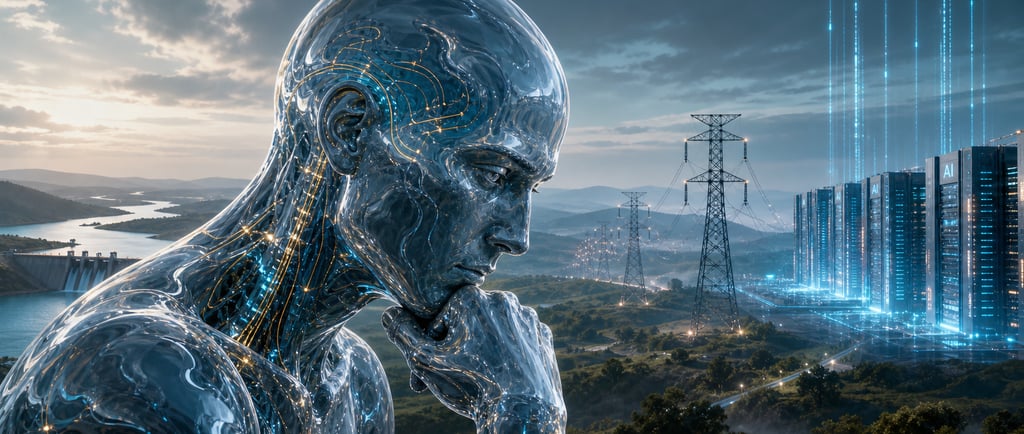
AI is fast approaching that same line. Not because chatbots are impressive party tricks (though they are), but because the underlying machinery, the chips, the data centers, the foundational models, the platforms everything else runs on, is weaving itself into the fabric of how hospitals make decisions, how courts analyze evidence, how supply chains keep shelves stocked, how children are educated. Once that happens at scale, we’re no longer talking about regulating a powerful industry. We’re talking about governing a new layer of civilization.
That’s a bigger question than most current AI policy debates admit. So let’s ask it properly.
The Infrastructure Test
How do you know when a technology has stopped being a convenience and become part of the skeleton of society? There’s a useful four-question test, not official, not from a think tank, just the clearest way I know to frame it.
First, would opting out impose severe social or economic penalties? Not inconvenience, genuine penalties.
Second, do a small number of providers become effectively unavoidable, because the network effects are just too strong?
Third, does this thing mediate access to other rights; to work, to healthcare, to political participation?
And fourth, when it fails or gets abused, does the harm fall on individuals, or does it ripple through entire systems?
Electricity passes all four. Broadband increasingly does. And core AI infrastructure, the handful of foundational models and cloud platforms that underpin more and more of economic and civic life, is passing them too. When hospitals, courts, and supply chains all depend on two or three providers’ systems, those providers aren’t just companies anymore. They’re gatekeepers. And gatekeepers to essential social functions have, historically, needed to be governed differently than, say, a sneaker brand.
Think of AI as a Layer Cake
One reason the AI governance debate gets muddled is that “AI” is doing a lot of work as a word. It refers to everything from the chatbot that helps you draft emails to the physical data centers that consume as much electricity as a small city. To think clearly about governance, it helps to see AI as a stack of layers or floors, like a building, not a gadget.
At the bottom, land, power, and cooling water for data centers.
Above that, the chips and compute clusters.
Then the foundational models themselves, the large, expensive to train systems everything else plugs into.
Then the platforms and APIs developers use to build on top.
And finally, at the top, the apps we actually interact with.
Most public debate happens at the very top; content moderation, chatbot safety, algorithmic bias. Those matter. But the infrastructural character of AI lives in the lower layers, where the real concentration, the real resource demands, and the real systemic risks are. And those lower layers look less like software companies and more like utilities. Training the most powerful models requires electricity and cooling water on the scale of towns. As AI’s demands grow, they’re not competing with other tech companies, they’re competing with households and farms for scarce resources.
Why the Old Approach Won’t Work
The standard model for governing technology goes like this; private companies build things, the government watches from outside, and when something goes wrong, regulators issue fines, impose rules, or pursue antitrust cases. It’s not elegant, but for modular markets with real competition and easy exit, it mostly works.
Infrastructure breaks this model in a specific way; by the time the harm is visible, the dependence is already entrenched. You can’t fine your way out of a situation where the entire healthcare system depends on one vendor’s APIs. Laws move slowly; companies adapt quickly; and fines, when they come, get absorbed as the cost of doing business. Budgeted for, essentially, like postage.
That’s why, for electricity and water and rail and telephones, societies eventually moved beyond pure regulation toward something more like co-governance, public ownership, public-private hybrids, boards with genuine public representation, government veto rights over fundamental decisions. The underlying logic was simple, if this system is now part of the polis, part of the shared infrastructure of civic life, then the public gets a seat at the table where the rules are made, not just a complaint window after the fact.
The question for AI is whether we’re willing to make that same move, and what it looks like.
Three Models Worth Stealing From History
The Public Utility
In the classic public utility model a company, sometimes publicly owned, sometimes not, is granted near-monopoly status in exchange for accepting genuine obligations; universal access, fair pricing, nondiscrimination, and long-term planning under public supervision. You’re allowed to be the only electricity provider in town, but in return, you have to serve everyone, at regulated rates, with the lights staying on even for people who aren’t profitable to serve.
Applied to AI, this might mean designating a handful of foundational model or compute infrastructure providers as systemically important, the AI equivalents of the grid. They’d be required to offer baseline services on fair terms, maintain resilience, disclose safety and resource information, and coordinate with public bodies on emergencies and national priorities.
The upside is real, it takes seriously the monopoly dynamics already forming and builds fairness obligations into the structure, not the fine print. The downside is also real, utility regulation can calcify markets around incumbents, reward blandness over experimentation, and create enormous lobbying incentives for the companies being designated. We’d be choosing stability over dynamism, and that trade off deserves honest debate.
The Public-Private Partnership
Public-private partnerships, PPPs, are the slightly awkward middle child of infrastructure governance. Private companies design, build, and operate things; governments provide capital, set terms, and retain oversight. Toll roads, water treatment plants, and power generation facilities often work this way.
In AI, this might mean governments co-funding regional data centers with private operators, where the public contract specifies access tiers, pricing principles, and environmental constraints, or shared compute clusters where private companies run the hardware but public goals shape who gets access and at what cost.
The appeal is pragmatic. Modern AI systems are far too complex and capital-intensive for governments to build alone. PPPs let you leverage private expertise and capital while encoding public values directly into the operating agreement. The risk is equally pragmatic, contracts are gamed, losses get socialized while gains get privatized, and when the technical knowledge lives entirely with the private partner, “oversight” can become a polite fiction. The history of PPPs is littered with cautionary tales. That doesn’t make the model wrong, it makes the design of contracts a matter of genuine political importance.
Public Ownership and Community Stakes
The most ambitious option is partial public ownership or community stakes in key AI infrastructure, governments or public funds holding equity, communities with genuine local impacts (data center towns, for instance) holding shares, public board seats with real authority over high-stakes decisions.
The philosophical appeal is direct, if a company’s infrastructure shapes the conditions of your life, you should have a voice inside the room where decisions are made, not just the ability to file a comment during public consultation. Communities that host data centers consuming their water and straining their power grid aren’t just bystanders to AI development, they’re co-bearing the costs. Some fraction of the upside ought to flow their way.
The risks are familiar to anyone who’s watched state-owned enterprises get turned into patronage machines; politicization, blurred accountability, minority stakes that are purely symbolic unless backed by genuine hard powers. Getting this right requires institutional design that’s genuinely hard, but “hard” and “impossible” are different things.
The Water and Power Problem
Here’s something that tends to get lost in debates that focus on the informational layer of AI, the systems are physically enormous. Training a frontier model can consume megawatts that would otherwise serve a regional grid. The cooling requirements pull millions of gallons from local water sources. In drought-prone regions, the American Southwest, for instance, those aren’t abstract externalities. They’re real constraints on a finite resource.
This matters philosophically in at least two ways. First, it’s a question of intergenerational justice, the water drawn to train models today is water not available to future residents. That’s the classic domain of public trusteeship, the same logic that governs how we manage national parks, public lands, and shared river rights. Private risk-taking doesn’t usually get to externalize its costs onto people who haven’t been born yet.
Second, it changes who counts as a stakeholder. A community that hosts a data center isn’t just a local employer story. It’s a community whose air quality, water supply, and electrical grid are being permanently reshaped by decisions made in San Francisco or Seattle. The question of consent and benefit can’t be reduced to job announcements.
Because water and power are already governed as infrastructure in most societies, AI’s deep dependence on them creates an overlapping jurisdiction. Any serious AI governance framework will have to harmonize with existing water and energy regulation, which means practically speaking, that energy and water agencies will become AI governance bodies whether they’re prepared for that or not.
This Is a Constitutional Question, Not Just a Policy One
Once you accept that AI is crossing the threshold into infrastructure, the governance question changes character. It’s no longer primarily about managing corporate conduct — it’s about constitutional design in miniature. Who has standing to decide how the system runs? What checks exist on concentrated power? How are people who can’t yet vote, future generations, protected from decisions made today?
Framed that way, the question shifts:
From: “How do we regulate AI companies?”
To: “What institutional forms ensure that AI as a durable layer of our shared environment, remains compatible with democratic self-governance and basic fairness?”
Public utilities, public-private partnerships, and community ownership aren’t just policy tools. They’re different answers to the question of who the system exists for. Each carries a distinct vision of the relationship between markets, states, and citizens. Choosing between them isn’t a technocratic exercise, it’s a political one, in the best sense of that word.
The case for hybrid public-private models is, at its core, a claim that when technology becomes the environment in which we think, trade, and deliberate, the people who live in that environment deserve more than consumer protections at the margins. They deserve a seat at the table where the system’s deep logic is set.
We built those seats into how we govern electricity and water. The question now is whether we’re willing to build them into how we govern AI before the concrete sets.
Reach out for collaborations or questions.
aldous@gerbrot.com
© Aldous Gerbrot 2026. All rights reserved.