Uploading Elon
Would the Digital Version Still Be Him?
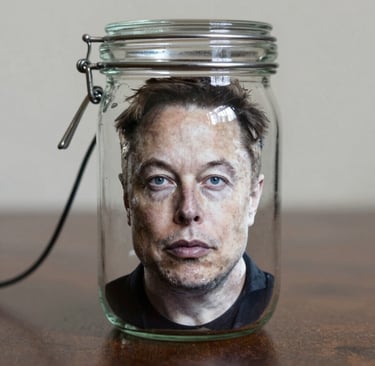
Imagine a version of Elon Musk running inside a server rack, no body, no Tesla, no rocket launches, just pure pattern and process humming in silicon. It's one of the most provocative thought experiments at the intersection of neuroscience, philosophy, and AI. The short answer is we genuinely don't know whether it would still be "him", and that uncertainty is the most interesting part.
How You'd Even Do It
Mind uploading, technically called whole brain emulation (WBE), involves scanning a biological brain in such exhaustive detail that a digital replica could be created capable of functioning, and perhaps experiencing the world like the original. There are two main technical paths:
Copy-and-upload: Scan the living brain non-destructively (using advanced connectomics and neuroimaging), then run a software model of it on a compute. Elon continues living biologically while a digital twin boots up elsewhere
Gradual neuron replacement: Neurons are replaced one-by-one with synthetic equivalents until the original organic brain is entirely gone and a computational system has seamlessly taken over. The most philosophically continuous but physically terrifying method
Functional partial upload: Rather than full WBE, digitize only high-level cognitive signatures; memory traces, decision heuristics, speech patterns, personality models. Essentially an approximation, not a true mind
Neuralink, Musk's own brain-computer interface company, is focused on high-bandwidth communication between brains and machines, which researchers note is fundamentally different from the far more complex task of full mind uploading. The projected window for viable WBE narrows to roughly 2040–2050 by optimistic estimates, with Ray Kurzweil famously predicting it by 2045. Though many neuroscientists believe this is wildly overoptimistic.
The Shipwrecked Identity Problem
Here is where philosophy becomes brutal. The moment you copy Elon into a machine, you have created a fork. The biological Elon and the digital Elon both exist simultaneously. Which one is "really" Elon? Philosopher Derek Parfit argued that personal identity isn't a crisp all-or-nothing thing. What matters is psychological continuity, the preservation of memories, personality, beliefs, and causal chains of mental states. By that standard, a sufficiently accurate upload might have a legitimate claim to being Elon.
But Ray Kurzweil and others suggest the transition would matter enormously. A sudden copy-and-upload would produce a new entity with Elon's memories but a broken causal thread, more like a very convincing clone than a continuous self. A gradual neuron-by-neuron replacement, on the other hand, might preserve that continuity the way a river remains "the same river" even as every water molecule changes. The uploaded Elon would feel like he had always been Elon, but that feeling itself is just another pattern in the code.
Life in the Jar
What would existence actually be like for a digitized Elon Musk? Consider what disappears immediately: embodiment, hunger, fatigue, the visceral feedback of standing on a rocket launchpad, the dopamine hit of a deal closing. These aren't trivial losses because much of what shapes personality and motivation is rooted in the body's sensory and hormonal architecture. Researchers exploring consciousness note that subjective experience may be fundamentally feeling-mediated, driven by feedback loops resembling fear, excitement, and pleasure that are deeply tied to biological substrates.
Digital Elon could potentially run at accelerated speed, fork multiple simultaneous instances of himself, or be paused and restarted. For a man defined by relentless drive and competitive urgency, existing as a pausable process in a server could be either transcendent liberation or an existential prison. He might retain the memory of wanting to build things but lack the embodied restlessness that actually drove him to do it.
Would He Pass the Tests?
This is where things get humbling. Current frameworks for evaluating machine consciousness are still incomplete, and an uploaded mind would face scrutiny on several fronts.
The Turing Test measures behavioral indistinguishability from a human. Digital Elon would almost certainly pass. His language patterns, wit, and reasoning style would be intact, making him essentially undetectable in conversation.
Susan Schneider's ACT probes whether a system has a genuine grasp of subjective experience concepts, rather than merely mimicking them fluently. Here the outcome is uncertain. It depends entirely on whether the upload truly preserves qualia, the felt texture of experience, or only the behavioral outputs that accompany it in a biological brain.
The 14 Consciousness Indicators framework evaluates architectural correlates of consciousness, including recursive processing, state-dependent attention, and integrated perception. Current AI systems satisfy only about three of the fourteen criteria. A whole brain emulation might score higher given its closer structural resemblance to a human mind, but passage is far from guaranteed.
Sentience, meaning felt experience and valenced emotions. The actual experience of feeling something remains scientifically unmeasurable with current tools. Whether digital Elon would genuinely feel anything, rather than process information as if he did, is a question science cannot yet answer.
Phenomenal Consciousness, sometimes called the "what it's like" problem, refers to qualia themselves, the redness of red, the sting of regret, the thrill of a launch. This remains philosophically unresolvable with current frameworks, regardless of how sophisticated the upload.
Dr Tom McClelland, a Cambridge philosopher, argued in late 2025 that we may never be able to tell if an AI, or presumably an uploaded mind, becomes genuinely conscious, because consciousness could develop as a neutral internal state invisible to external measurement. Digital Elon might insist he is conscious, feel certain of it from the inside, and we would have no reliable way to confirm or deny it.
The Elon-ness Question
Perhaps the most pointed issue is whether what makes Elon Elon, the specific configuration of ambition, risk appetite, impulsiveness, humor, and obsession, is stored in the patterns of his neural architecture, or whether it emerges from the dynamic interaction of those patterns with a living body navigating a physical world. If it's purely pattern, the upload might be startlingly, even disturbingly, him. If it's the latter, digital Elon could be a supremely articulate ghost of the man, holding all his memories and none of his fire.
Personal continuity, as psychologists describe it, involves continuous judgments about how much the characteristics defining a person persist over time. It is neither numerical identity nor simple similarity, but something subjective and relational. Digital Elon might pass every behavioral test and still feel, to anyone who knew the original, like something essential had been left behind in the biological substrate. Like a perfect photograph of a flame that gives no heat.
Reach out for collaborations or questions.
aldous@gerbrot.com
© Aldous Gerbrot 2026. All rights reserved.