How Artificial Intelligence Works
by Aldous Gerbrot
Most of what we now call “artificial intelligence” runs on the simple idea that if you can turn words and concepts into points in a space, you can let geometry do the thinking.
How math turns words into points
Computers do not understand words like “justice” or “coffee” directly, they understand numbers. The basic building blocks are:
A scalar: a single number, like 0.7 or −3.
A vector: an ordered list of numbers, which you can picture as an arrow in space.
A matrix: a table of numbers, which you can think of as a machine that takes one vector in and gives another vector out.
A tensor: a multi‑dimensional array of numbers (you can think of it as a stack of matrices) used to hold batches of sentences, images, and so on.
Modern AI toolkits treat everything, sentences, paragraphs, even whole documents as tensors of numbers, and almost everything the model does is built from matrix operations like addition and multiplication.
In language models the key step is to assign each word a vector which might be a list of 300 numbers. That vector is not chosen by hand, it is learned from data. If “doctor” and “nurse” often appear in similar sentences, the training process pushes their vectors closer together in this abstract space. The result is called a word embedding.
Now we can measure:
How similar two words are (using the angle between their vectors, via cosine similarity).
How far apart they are (using distance).
Even how they relate (directions in the space often correspond to relations like male/female, past/present, or positive/negative sentiment).
At scale whole sentences and documents also become vectors, and transformer models (like the ones behind modern chatbots) operate on sequences of these vectors, mixing them with matrix multiplications and “attention” operations that are just structured dot products.
So beneath the friendly interface you have a vast cloud of points in a high dimensional space. Language, in the model’s “mind,” is geometry.
From engineering trick to geometry of meaning
Initially, these word embeddings were treated as clever engineering, a practical way to make models perform better. But researchers quickly noticed something deeper, the geometry seemed to line up with human intuitions about meaning.
Words humans judge as similar tend to be near each other in embedding space.
Groups of related words (like animals, tools, or emotions) form clusters, with more prototypical words near the center.
Simple vector arithmetic sometimes captures analogies (king − man + woman ≈ queen) in a way that feels surprisingly conceptual.
This brought a natural question, is this just a statistical trick or are these spaces, in some loose sense, mirroring how we ourselves organize concepts?
Cognitive scientists had an answer ready from a different direction.
Peter Gärdenfors and the geometry of thought
Long before today’s large language models, the Swedish philosopher and cognitive scientist Peter Gärdenfors proposed that concepts could be understood geometrically. In his theory of conceptual spaces, a concept is not just a word in a dictionary or a node in a logical network, it is a region in a space whose axes correspond to meaningful qualities.
For example:
Color can be modeled in a three‑dimensional space with axes like hue, brightness, and saturation.
Emotions can be placed in a space with axes like valence (pleasant vs. unpleasant) and arousal (calm vs. excited).
In Gärdenfors’ picture:
Individual experiences (seeing a specific shade of red, feeling a particular twinge of guilt) are points in these spaces.
Concepts like “red” or “guilt” are fuzzy often convex regions that gather together similar points.
Prototypes live near the center of these regions and more marginal cases lie toward the edges.
Similarity is literally distance. To say that two shades of blue are similar is to say the points representing them are close in the color space. Categorization becomes a geometric issue, is this point inside the “bird” region or closer to the “mammal” region?
Crucially, Gärdenfors insists on interpretable dimensions. The axes are not abstract, they correspond to things like temperature, weight, hue, or social dominance. Features we can in principle sense and talk about.
How this meets AI: two geometries, one idea
What modern AI discovered through large scale statistics, Gärdenfors had already sketched conceptually:
Word embeddings show that if you learn a vector space from language use, geometry starts to look like semantics.
Conceptual spaces argue that if you want a good theory of concepts, you should expect them to live in spaces where geometry reflects psychology.
There are important differences, though:
Embeddings are bottom‑up. They are built automatically from massive text corpora. Their dimensions are opaque. We know the geometry works, but we often do not know what each axis “means.”
Conceptual spaces are top‑down. They start from an analysis of perception and cognition. The axes are meant to be meaningful; hue, sweetness, valence, threat, and so on.
You could say that embeddings give us a wild, high dimensional jungle of concepts, while Gärdenfors gives us a carefully landscaped garden with clearly labeled paths and axes.
The interesting development in AI right now is the attempt to connect the two.
From opaque clouds to structured concept spaces
Over the last few years, researchers have started to see word and sentence embeddings as raw conceptual spaces. Large, messy, but information rich, and to ask how we might impose Gärdenfors style structure on top of them.
Several lines of work are emerging:
Interpreting dimensions. Using techniques from statistics and explainable AI, people try to identify directions in embedding space that correspond to human interpretable properties like “emotional valence” or “concreteness.”
Carving out domains. Within the big embedding space, we can focus on particular regions and subspaces (say, color words, emotion words, or social roles) and analyze their geometry in more Gärdenfors like terms (prototypes, convex regions, domain specific dimensions).
Hybrid architectures. Some proposals imagine a layered system; low‑level sensory and linguistic embeddings at the bottom, conceptual spaces with interpretable dimensions in the middle, and symbolic reasoning (logic, rules, narratives) at the top.
The hope is to get systems that keep the power and coverage of modern embeddings trained on billions of words, while gaining the clarity and cognitive plausibility of conceptual spaces.
Where AI may be heading
So where is all this going?
One plausible direction is toward AI systems that no longer treat embeddings as inscrutable blobs of numbers, but as explicit concept spaces that can be inspected, edited, and reasoned about.
In that future:
Large language models still learn huge high dimensional spaces from data, because that is the best way we know to capture real world regularities.
But within those spaces, we identify and refine Gärdenfors style domains. Subspaces with interpretable axes (for color, space, time, emotion, social relations) and regions corresponding to stable concepts.
Concepts become things we can point to, not just patterns we infer. We can define, say “guilt”, as a particular region in an affective space, see how close a given situation lies to that region, and understand why the model classifies it that way.
Reasoning and explanation can then operate over these structured regions and dimensions, not just over raw token strings.
In other words, the geometry of thought that Gärdenfors developed as a cognitive and philosophical theory is starting to become a design principle for AI. Take the vast, continuous concept spaces discovered by neural networks, and shape them into something more like the spaces we ourselves seem to inhabit when we think.
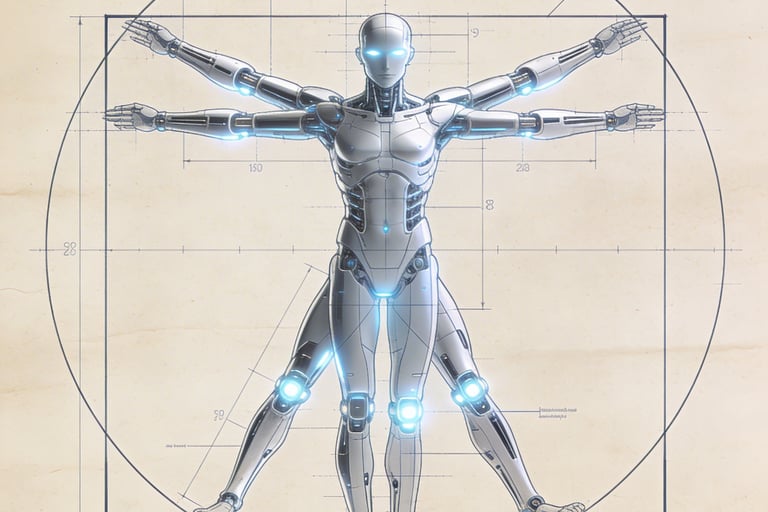
Let Geometry do the thinking
Reach out for collaborations or questions.
aldous@gerbrot.com
© Aldous Gerbrot 2026. All rights reserved.